Heyyy bookish/theater/history besties!
Today we need to discuss Suffs, the full women-led Broadway musical about the American suffrage movement that I watched via PBS Great Performances, because apparently my idea of a relaxing Friday night is crying over constitutional amendments, ideological splits, hunger strikes, and women in period clothing absolutely dragging a president.
Of course, as a history nerd, I know a thing or two about the suffrage movement. I took an American Women’s History class in college where I watched Iron Jawed Angels for the first time…which means I have personally victimized by Alice Paul content before. So going into Suffs, I was ready. I had context. I had emotional preparedness.
Or so I thought.
Reader, I was not prepared.
Because this musical said, “What if we told the story of the suffrage movement with humor, rage, nuance, gorgeous music, historical honesty, and enough scenes that will make you cry and therefore question whether you’re still hydrated or not?”
The Basic Plot aka Women Doing the Most Because Men Did The Bare Minimum
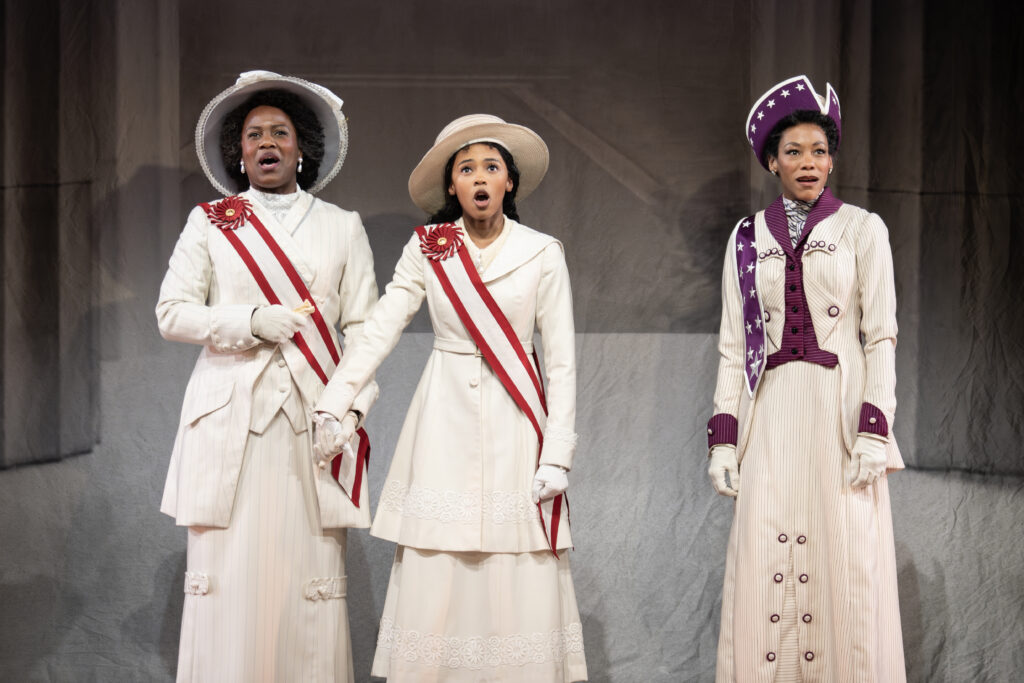
Suffs follows the fight for the 19th Amendment from the years 1913-1920 through the eyes of women like Alice Paul, Carrie Chapman Catt, Ida B. Wells, Mary Church Terrell, Inez Milholland, and more.
It’s about activism, strategy, ego, racism inside reform movements, generational conflict.
About women fighting for power while also fighting each other because organizing a movement is basically group project trauma with corsets and high stakes.
About women fighting against Woodrow Wilson and his stubborness about ratifying the 19th Amendment.
If I had beef with one historical president, it’d be him.
No, I will not go into why at this date.
Just know the beef is there.
The Cast Came to Work
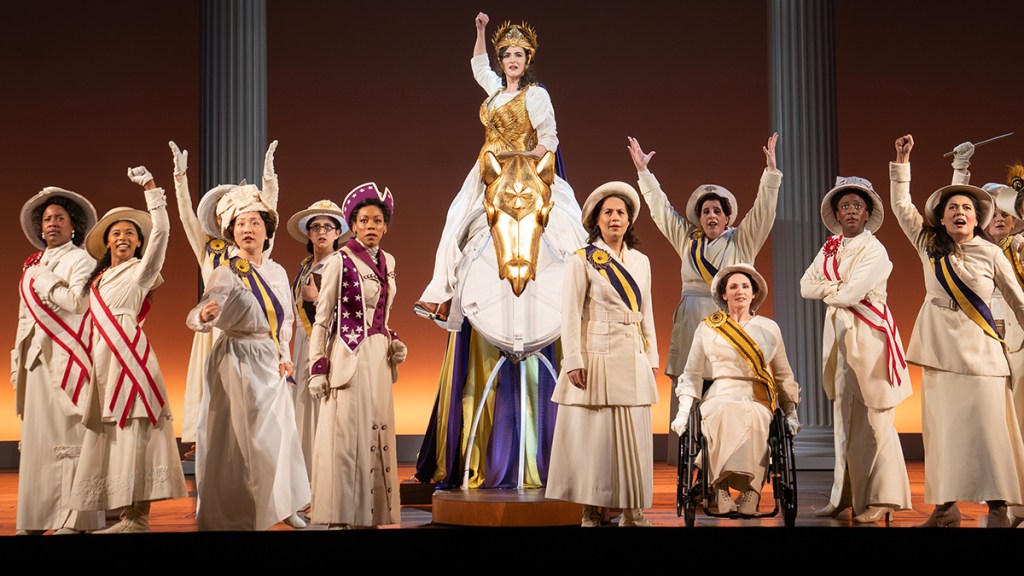
First of all, Shaina Taub plays Alice Paul, and she also wrote the music, book, and lyrics.
Excuse me?
Standing ovation.
Her Alice Paul is driven, brilliant, stubborn, idealistic, ambitious, and occasionally so tunnel-visioned you want to grab her by the shoulders and say, “Girl, listen to literally anyone else in the room for five seconds.”
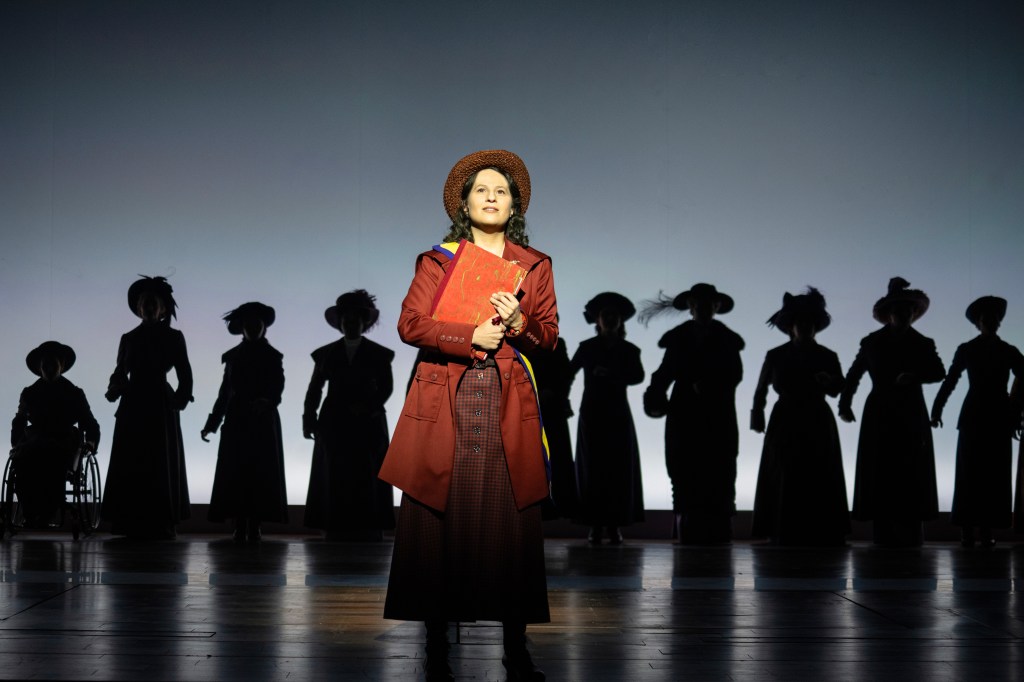
Then we have Jenn Colella as Carrie Chapman Catt, and as always, Colella is fantastic. Catt represents the older guard of the suffrage movement, the woman who has been in the fight forever and does NOT have the patience for Alice Paul acting like she invented activism.
Their dynamic is one of the best parts of the show because it’s not just “old way vs. new way.” It’s more complicated than that. It’s strategy vs. urgency. Respectability vs. disruption. Patience vs. pressure.
Then there is Nikki M. James as Ida B. Wells.
Ida B. Wells is one of my favorite historical figures.
Is that weird?
Honestly, no. She was brilliant, fearless, sharp, and had the energy of a woman who could destroy your entire argument with one sentence.
In Suffs, Ida is exactly what she should be: righteous, clear-eyed, and absolutely unwilling to let white suffragists pretend race is a tiny side issue they can just put in a drawer until later.
Because spoiler alert: they did that a lot.
History is messy. Reform movements are messy. People can be fighting for justice in one direction while being deeply unjust in another, and Suffs doesn’t let anyone off the hook for that.
We also get Hannah Cruz as Inez Milholland, who brings such elegance and hilarity to the role. Inez is one of those historical figures who feels almost cinematic already: beautiful, charismatic, bold, dramatic, and tragic.
And we have Anastacia McCleskey as Mary Church Terrell, another major figure who absolutely deserves more mainstream attention. Terrell was also deeply important to the fight for both women’s rights and racial justice.
Suffs does not flatten these women into cute little historical dolls. It lets them argue. It lets them be brilliant, flawed, principled, and tired.
Oh, so tired.
My Favorite Character Though…
My favorite character?
Ruza Wenclawska, played by Kim Blanck.
Hilarious.
Immediately iconic.
Every time Ruza showed up, the show got ten times funnier. She brought the kind of chaotic best friend energy that every group fighting social injustice needs. I loved her. I would watch an entire side musical about Ruza judging everyone and saying the thing everyone else is too tired or polite to say.
She gave comic relief without feeling pointless, which is important because in a musical dealing with arrests, hunger strikes, racism, sexism, and political betrayal, you need someone who can pop in and remind the audience to breathe.
Ruza understood the assignment.
The History Nerd Corner
One thing I really appreciated about Suffs is that it actually respects the history.
Not in a dusty textbook way.
It respects the history by showing how complicated the movement really was.
Yes, some suffragists went on hunger strikes after being arrested.
Yes, women were jailed and abused for protesting.
Yes, the movement split because Alice Paul and Carrie Chapman Catt had very different ideas about strategy and leadership.
Yes, Mary Church Terrell and Ida B. Wells had ideological tension too.
What I REALLY respected was the fact that the musical does NOT treat the ratification of the 19th Amendment as a neat happy ending.
Because it wasn’t.
Yes, the 19th Amendment was a massive victory. Of course it was. Women fought, organized, marched, petitioned, died, endured arrest, hunger strikes, ridicule, and political nonsense to get there.
But the amendment did not magically open the ballot box for everyone.
Black women, Native women, Asian American women, Latina women, and other marginalized communities still faced voter suppression, racist laws, citizenship restrictions, and ststem barriers.
And Suffs says that.
It does not dress history up in a little sparkly outfit and go, “And then freedom happened and everyone was happy, the end!”
No.
It says: progress happened. It mattered. It was incomplete. The fight continued.
That is the kind of historical storytelling I love.
Give me the win, but don’t lie to me about the cost.
The Music? Emotional Damage with Harmonies
Now let’s talk about the songs.
Because whew.
The music absolutely got me.
There are two major songs that gave me goosebumps watching this show.
The song “How Long” sung after the death of a major character made me cry. Not cute little misty tears. Actual tears. I sobbed.
The song aches with exhaustion. It asks how many more women have to fight, suffer, be ignored, be dismissed, be erased, be sacrificed before the world finally changes.
Absolutely devastating.
That song understands the weight of fighting for something that should already have been yours.
Then there’s “Keep Marching,” the ending song, which nearly finished me off.
That song is not a neat little “yay, we did it!” finale.
It’s a torch-passing song.
It reaches both backwards and forwards through time and generations of women saying: we did not finish the work, and neither will you, but that does not mean the work does not matter.
That hit me hard.
Because that is history.
Progress isn’t one clean staircase upward. It’s messy. It’s slow. It moves forward, backward, sideways, and occasionally trips over its own two feet. People fight for rights they may NEVER enjoy themselves. They push the world a little closer to justice, knowing the next generation will have to keep pushing too.
That is painful.
That is beautiful.
That is why I cried.
Rude.
Why This Musical Should Be Shown In Schools
Okay, I don’t think this just because I’m a history nerd and believe everyone should get emotionally damaged by suffrage history at least once. (Although…yeah.)
It should be shown because it makes history feel alive.
Students need to see that these movements were not just made up of marble-statue women in black and white photos looking sad next to banners. These were real people. Young women. Older women. Black women. White women. Immigrant women. Working women. Wealthy women. Funny women. Angry women. Brilliant women. Petty AF women. Brave women. EXHAUSTED women.
They disagreed.
They messed up.
They kept going.
That is such an important lesson.
History is not made by perfect people. It’s made by people with vision, flaws, stubborness, courage, blind spots, and sometimes absolutely atrocious people skills.
Also, musicals are a fantastic teaching tool because songs sneak info into your brain.
For example, because of Hamilton, I actually know what happened at the battle of Yorktown, 1781.
A student might forget a paragraph from a textbook.
They won’t forget about a song that makes them feel something.
Final Verdict
I LOVED Suffs.
I loved the performances. The music. The historical nuance.
I loved that it made me laugh and then immediately punched me in the feelings.
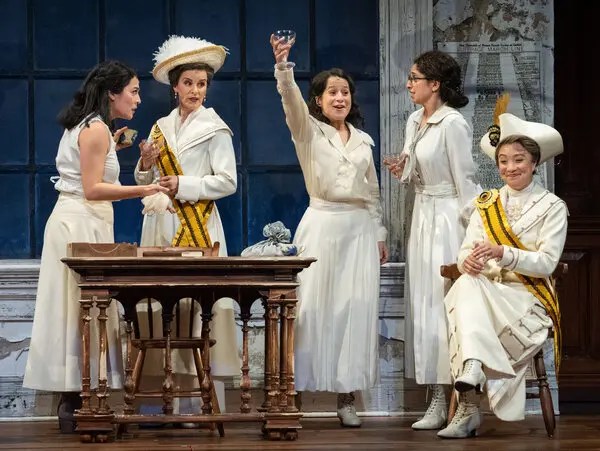
I loved that it did not flatten the suffrage movement into a girlboss parade with matching sashes and no uncomfortable truths.
It was moving. It was funny. It was honest. It was educational without feeling like homework.
And yes, again, I cried multiple times.
Of course I did.
I’m a history nerd with feelings and access to PBS.
If you love musicals, watch it.
If you love history, watch it.
If you teach history, show it.
If you have ever had beef with Woodrow Wilson, gather around. My table has room.
Suffs is the kind of musical that makes you want to learn more, argue with dead presidents, appreciate the women who came before us, and then go do something with all that righteous energy.
In other words:
Keep. Marching.
Also, there’s a song called “Great American B****“, and it might be my new anthem.


Leave a Reply