There are some bookish things I can handle with grace.
A plot twist? Fine.
A beloved character death? I’ll sob into my blanket but I will survive.
A slow burn that takes 600 pages and three near-death experiences before anyone admits they have feelings? Annoying but delicious. Immediately buying it.
But there are certain bookish offenses that activate something ancient and theatrical in me.
Yes, I love books. Obviously. I love bookstores. I love libraries. I love readers. I love the whole strange, beautiful ecosystem of humans voluntarily emotionally damaging themselves with paper.
But some things?
Some things make me dramatic.
So today, we’re discussing my bookish pet peeves.
Let’s jump right in.
1. When bookstores or libraries do not have Book 1
This is my villain origin story.
There is nothing more disorienting than walking into a bookstore, finding a series that seems amazing, and then realizing they have Book 2, Book 3, Book 5, a random novella, a spin-off prequel, but not Book 1.
Excuse me?
Now, I understand that bookstores and libraries cannot stock everything. I do. My rational brain understands logistics, inventory, publishing cycles, and shelving limits.
But my reader brain?
My reader brain is standing in the aisle holding Book 3 like:
“So am I just supposed to commune with the ancestors and learn what happened in Books 1 and 2 through osmosis?”
Okay, yeah, obviously you can get Book 1 ordered. Sometimes the library has it digitally or you can buy a copy on your e-reader.
But when you want that physical copy? In that moment? Pain. Confusion. Betrayal. Tiny violins.
2. Book covers with fake stickers
Whoever decided to print fake stickers directly onto book covers, I just want to talk.
Not fight.
Talk.
In a locked room.
With no witnesses.
Because friend…why?
A real sticker is already stressful enough.
But a fake sticker?
That’s just emotional vandalism.
“Now a major motion picture!”
“TikTok made me buy it!”
“Over 1 million copies sold!”
“Soon to be a streaming series!”
“Now on Netflix!”
That’s cute. Congratulations. I’m happy for the book and love with authors get their accolades and coins.
But why is it tattooed onto the cover forever?
I want the art. I want the vibes. I want the cover designer’s vision.
And that vision probably did not include a promotional pimple in the corner.
3. Mid-series cover changes
Few things hurt like committing to a series, buying the first few books, admiring how pretty they look together, and then suddenly the publisher changes the cover style halfway through.
Now Book 1 – illustrated.
Book 2 – photographic.
Book 3 – minimalist.
Book 4 – looks like it belongs to an entirely different genre.
Why?
Do you not understand that readers are collectors, decorators, archivists, and emotionally unstable dragons?
We like our series to match.
We like uniform spines.
We like looking at the shelf and seeing order, beauty, and more importantly, continuity.
A mid-series cover change says, “No peace for you, little book gremlin.”
And special mention to height changes.
Because again…why?
4. No Blurb on the Back Cover, Only Reviews
You know the drill.
You pick up a book, turn it over, and expect a plot summary.
Instead, you get:
“Breathtaking.”
“Unputdownable.”
“A dazzling triumph.”
“A literary tour de force.”
“Will leave readers spellbound.”
Respectfully, what is the book about?
Is there murder? A dragon? A sad woman in a coastal town? A fake dating situation? A cursed family? A haunted house? A morally gray man with exquisite cheekbones and secrets? Am I going to cry? Am I going to be confused? Am I going to need a family tree, a map, or therapy?
Tell me.
I don’t need 12 authors and magazines to yell compliments at me.
Imagine going to a restaurant and the menu just says:
“Exquisite.”
“Life-changing.”
“A stunning acheivement in soup.”
Like, okay, buuuuuuuut is it tomato? Clam chowder?
You get the point.
5. Girl Hate for No Reason
Few things make me side-eye a book faster than random girl hate.
You know the vibe.
The main character is “not like other girls,” and every other woman in the story exists only to be shallow, mean, vain, stupid, jealous, or obsessed with makeup in a way that the narrative clearly wants us to judge.
Enough.
Give me complicated female friendships. Give me rivals who respect each other. Give me messy sisters. Give me women who hurt each other for actual reasons rooted in character, history, ambition, fear, loyalty, betrayal, or survival.
But do not give me “she wears pink, therefore she is evil.”
Also, let girls be feminine without punishing them narratively. Let girls love makeup and swords. Let them be soft and dangerous. Let them wear lip gloss into battle. Let them cry and still save the kingdom. Let them be amazing and annoying and kind and jealous and brave and complicated.
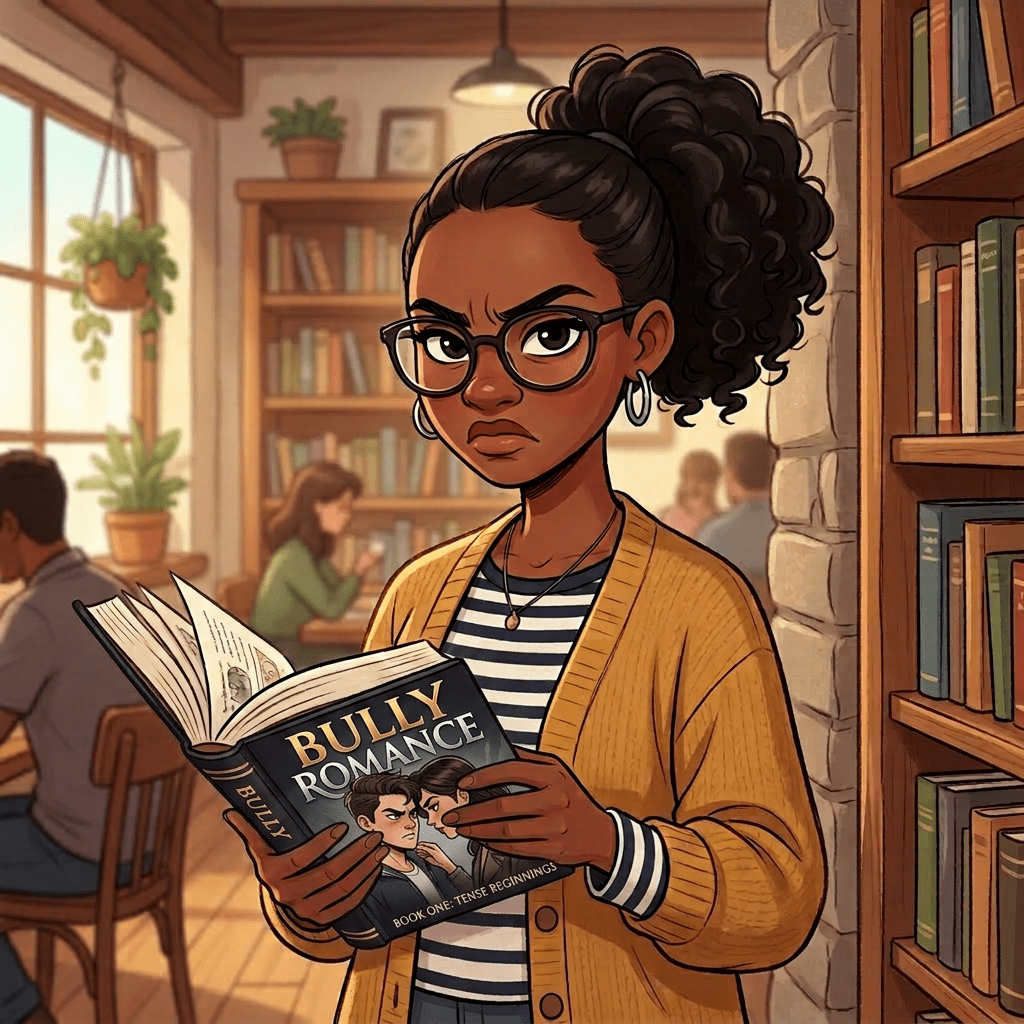
6. The bully romance trope
Now listen.
Everyone can read what they want. We are not judging readers here.
But as for me?
The bully romance trope often has me squinting at the page.
Usually, it’s just: “This man was emotionally, socially, and psychologically vile to her, but because he’s hot, we’re supposed to swoon.”
No.
If he ruined her life in chapter 3, I need more than “he secretly liked her the whole time.”
That is not romance.
That is poor behavior.
With abs.
7. Love triangles where we know who the winner will be
Please stop pretending this is a competition when one man has clearly been written in golden lighting and the other man has the narrative energy of a damp napkin.
You know exactly what I mean.
There is always one love interest who gets the banter, the emotional scenes, the tragic backstory, the forehead touches, the “he sees the real her” moments, and the meaningful eye contact.
Then the other love interest is just…there.
And we are supposed to be pretend this is suspensful?
Girl, please.
I don’t hate love triangles on principle. A good love triangle can be delicious.
But if the triangle is obviously line wearing a fake mustache, I cannot take it seriously.
Let both options matter.
Let both relationships mean something.
Make me sweat a little.
Otherwise, it is not a love triangle. It’s just a straight line.
8. Unfinished book series
There’s a very specific pain in loving a series that may never be finished.
Looking at you, George R. R. Martin.
You invest time. You learn the lore. You memorize family trees, prophecies, magical rules, fictional political systems, and who betrayed who. You have theories. You have hopes.
And then?
Nothing.
Years pass.
Even decades pass.
You are older. Wiser. More tired. Probably paying a mortgage now.
Still no final book.
I know authors are human beings, not book machines. They have lives, grief, health issues, creative blocks, contracts, burnout, and the general horrors of existing on planet Earth.
I respect that.
But the reader ache is real.
9. Judging people for what they read
This one actually makes me less funny-dramatic and more genuinely annoyed.
Because reading is reading.
If someone loves graphic novels, amazing.
If someone loves manga, fantastic.
If someone reads YA as an adult, cool.
If someone reads dark romance, okay.
If someone reads cozy mysteries, literary fiction, fantasy doorstoppers, celebrity memoirs, erotica, sports romance, middle grade, classics, fanfiction, audiobooks, or the back of a cereal box, who cares?
Are they reading?
Are they enjoying themselves?
Are they finding stories that means something to them?
Then leave them alone.
Now, obviously, people can critique books. We can discuss harmful tropes, bad writing, lazy representation, genre conventions, ethics, taste, craft, and impact. That’s different.
But mocking entire groups of readers because their preferred books don’t match your personal interests?
Ew.
The world is on fire.
Let people enjoy things.
10. “I can relate to this alien, but not this person of color.”
So this isn’t exactly a pet peeve.
This is a real problem.
Some readers will pick up a book about a 900-year-old immortal fae warrior with wings, a morally conflicted vampire prince, a dragon-shifting war criminal, or an alien with blue skin and say, “So relatable.”
But then a book has a Black girl, an Indigenous boy, an Asian woman, a Latina lead, a Muslim teen, a disabled protagonist, or literally anyone outside their immediate lived experience, and suddenly it is “hard to connect.”
Really?
You can relate to the ancient space emperor, but Keisha from New Jersey is where your imagination clocks out?
Be serious.
Books are supposed to expand us. They are supposed to let us live inside other minds, other worlds, other histories, other heartbreaks. If someone can empathize with elves, ghosts, assassins, robots, monsters, and morally gray men with shadow magic, they can empathize with people of color.
Final Verdict
The thing about bookish pet peeves is that most of them come from love.
We complain because we care. We rant because books matter to us. We get dramatic because reading is not just a hobby, it is a lifestyle, a coping mechanism, and sometimes a full-contact emotional sport.
So yes, I will continue to sigh dramatically when Book 1 is missing.
I will continue to side-eye fake cover stickers.
I will continue to want matching covers, actual blurbs, better female friendships, thoughtful representation, etc.
And I will absolutely continue judging people who judge other people’s reading choices.
Because at the end of day, whether someone is reading graphic novels, YA fantasy, romance, thrillers, fanfic, or a 900 page epic fantasy with a map, they are reading.
Let people have their stories.
Let people have their joy.
And please, for the love of all that is holy, put Book 1 on the shelf.


Leave a Reply