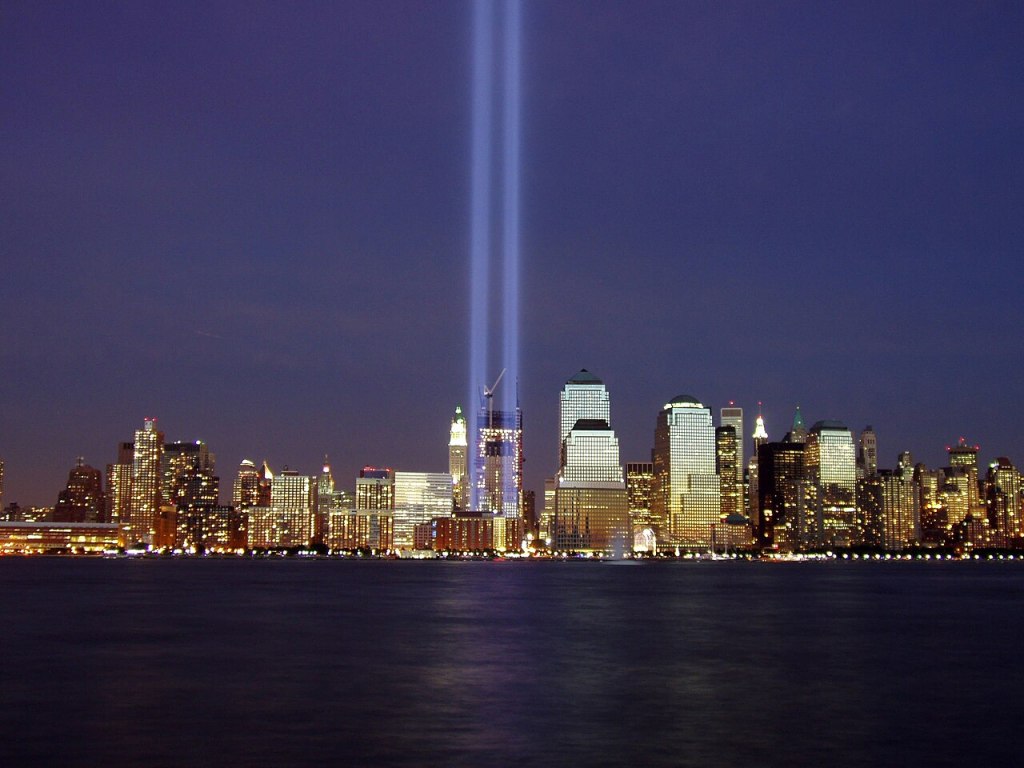
Twenty-five years ago, on September 11, 2001, I was ten years old and in the 5th grade in a relatively small town in New Jersey.
It was my dad’s birthday, and my biggest concern that morning was probably whether we were having chocolate or vanilla cake.
At school, they didn’t tell us anything.
Looking back, I think that was intentional. Maybe the adults knew that whatever innocence we had when we arrived would be gone by the time we went to bed. So for a few more hours, we got to worry about homework, recess, who was sitting with who at lunch, and birthday cake.
When I got home, the first weird thing thing I noticed was that my mom was already there.
She normally didn’t get off work until I had been home from school for a couple of hours.
I immediately knew something was up.
She asked me if I knew where the World Trade Center was.
I did not.
I had actually only ever heard the buildings called the Twin Towers, so I thought about it and confidently guessed:
Canada.
Listen.
Give 10 year old me a break.
My mom told me the World Trade Center was in New York City.
Now that meant something to me.
I LOVED New York City.
My dad’s parents lived there, and even as a kid, I was fascinated by it. The diversity. The history. Broadway. The Yankees. The crowds. The hustle and bustle. The glam. The street vendors selling kebabs. 5th Avenue. The fact that you could seemingly turn a corner and see something completely random happening.
In fact, only a few weeks earlier, after visiting my grandmother, my dad had pointed up to the Twin Towers (which I figured out was the World Trade Center), and said one day he’d take my brother and I all the way up to the top.
New York felt huge and exciting and alive.
Then I looked at the TV.
For a few moments, I genuinely thought I was watching a trailer for some new horror movie.
The North Tower was already pouring smoke into the sky, and then I saw the footage of United Airlines Flight 175 crashing into the South Tower.
Then the TV switched to the news anchors speaking.
And slowly it registered.
This wasn’t a movie.
This was real.
The news just kept showing more.
People standing in the streets staring up at the towers.
People trapped inside.
People jumping.
The towers collapsing.
The Pentagon on fire.
People standing around a fiery crater in a field in Pennsylvania.
Adults crying.
Missing posters.
I didn’t know what terrorism was. I didn’t know what al-Qaeda was. I definitely didn’t understand geopolitics, intelligence failures, or why anyone would deliberately fly an airplane full of people into a building also full of people.
Suddenly, the world felt a lot scarier than it had when I left for school that morning.
The Things Kids Remember
I think a lot of millennials who were kids on 9/11 have memories like that.
Not necessarily a perfect timeline of events, but these incredibly vivid little pieces.
Where you were.
Who told you.
What the television looked like.
What your parents looked like.
And maybe most importantly, the moment you realized the adults were scared too.
Afterward, I had fears I hadn’t really thought about before.
Planes.
Heights.
Tall buildings.
Being trapped somewhere.
And underneath all of that was the bigger realization that terrible things could happen in normal places on completely ordinary mornings.
I have a visceral memory of 9/11.
But I also remember 9/12.
I remember the flags everywhere. Candlelight vigils. Signs. People checking on each other. This overwhelming feelings, at least through the eyes of a 10 year old, that everyone had suddenly come together. That for a moment, just a moment, the United States seemed truly united.
That memory has stayed with me too.
Every September since, I end up going dowwn a 9/11 rabbit hole. Documentaries, interviews, survivor stories, news footage, books, remembrances for those who passed. I revisit it every year, partly because I remember it so vividly and partly because I still feel like I’m trying to understand the day in ways 10 year old me obviously couldn’t. But this year feels different.
25 years is a long time. We’ve reached the point where 9/11 is no longer just a major event from my childhood; it is firmly history now. There are full-grown adults who weren’t alive yet. Kids are learning about it in school from teachers who may not even remember it themselves. And somehow realizing that a quarter century passed makes the memories feel farther away. Maybe that’s why this anniversary hit me harder than usual.
So, Why The Only Plane in the Sky?
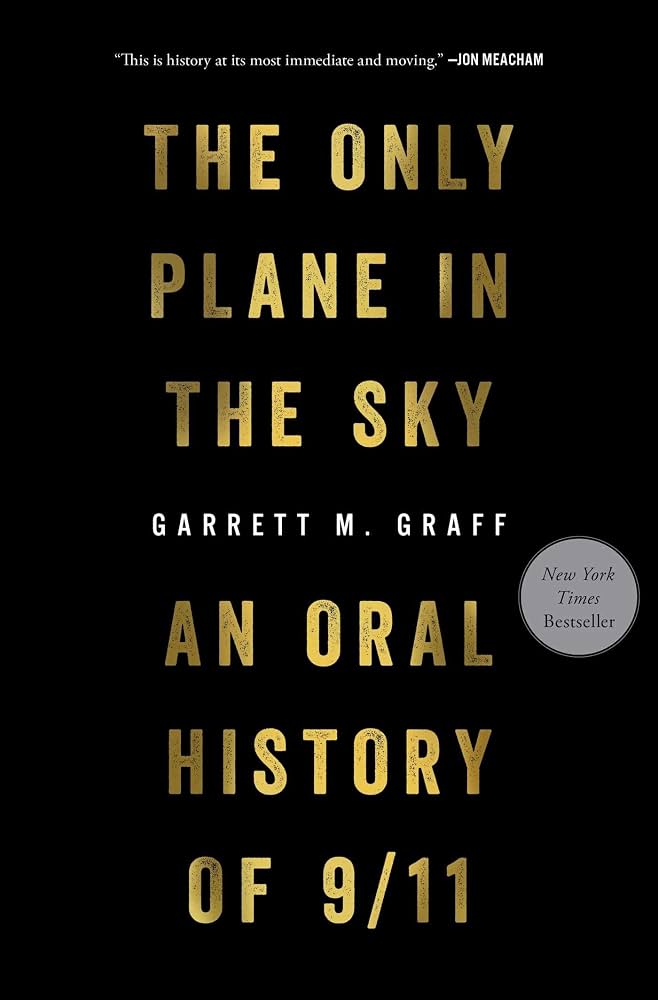
That childhood perspective is a huge part of why I wanted to read Garrett M. Graff’s The Only Plane in the Sky: An Oral History of 9/11.
There are plenty of books about September 11 that focus on timelines, politics, intelligence failures, military decisions, investigations, and everything that led up to or followed the attacks.
This book does something different.
It says:
Here are the people who were there.
Listen to them.
And that’s what makes this book so powerful.
This book is made up of the voices of people who experienced September 11 from pretty much every angle imaginable.
- people inside the World Trade Center
- people trying to escape the area
- firefighters
- police officers
- paramedics
- people at the Pentagon
- air traffic controllers
- FAA employees
- journalists
- government officials
- people standing on sidewalks in Manhattan staring up at the burning towers
- people across the country and even the world watching everything unfold
There’s even a section about the kids who experienced that day.
That one got me.
Because suddenly I wasn’t just reading about 9/11 as this giant historical event.
I was reading memories that sounded like my own.
Kids sitting in classrooms while teachers whispered in the hallways.
Kids who weren’t told what was happening.
Kids whose parents suddenly showed up at school.
Kids who woke up in one version of the world and went to sleep in another.
That section really drove home something I kept thinking about while reading this book:
We all experienced the same event, but everybody experienced a different September 11.
The Best Thing This Book Does
The Only Plane in the Sky brings the day back to life in a way no other book has before.
First, I have to mention the audiobook. If you can give it a listen, I absolutely recommend it. It has a cast of 45 narrators, and for a book built around dozens and dozens of different voices, that format works incredibly well. One person remembers something.
Then another.
Then another.
It makes the oral history structure feel immediate.
There were also archival audio woven throughout from in-flight communications and air traffic control. There were moments when the narration would give way to an actual recording from that day and I’d just stop whatever I was doing to listen. It’s one thing to read what someone said on September 11. It’s another thing entirely to hear a voice from that morning coming through your headphones.
Second, this book makes that day confusing. Chaotic. Terrifying. Which adds to how the day must have been for those who directly went through the horrific events. You hear people doing completely ordinary things while history is happening around them. Someone is trying to call their spouse. Someone is looking for a co-worker. Someone is deciding whether they should leave their office. Someone is going for a smoke.
The entire time you’re reading this, you know things these people don’t know yet.
When I was reading, I wanted to reach through the book and scream at people to leave the building. Take a different flight. Stay home.
But you can’t.
All you can do is listen.
This is what makes this kind of oral history so effective. These people aren’t telling you the story as clean facts. They’re telling you what they saw, what they thought was happening, what they were afraid of, and what they did next. Their memories are messy because living through something like that was messy.
There were definitely moments when I had to put the book down for a minute. Not because I wasn’t interested, but because sometimes the humanity of it hit me hard.
25 Years Later
It’s genuinely weird to me that September 11 happened 25 years ago.
There’s the history of September 11.
History remembers 4 hijacked planes.
The Twin Towers.
The Pentagon.
Shanksville, Pennsylvania and Flight 93.
Nearly 3,000 people killed.
And then there’s memory.
Even now at 35, I can still picture that TV.
I can remember guessing Canada.
I can remember thinking I was watching a movie.
Someone else might remember a classroom.
A phone call.
A television that stayed on all night.
A teacher whispering in the hallway.
A parent suddenly appearing at school.
A loved one who never came home.
History and memory aren’t always exactly the same thing.
History tells us what happened.
Memory tells us what it felt like.
That’s what The Only Plane in the Sky understands better than almost anything else I’ve read about 9/11.
Huge historical moments are made up of millions of tiny human moments.
Some heroic.
Some horrifying.
Some heartbreaking.
Some completely ordinary.
Eventually, those individual memories are going to disappear.
The people who were adults on September 11 are getting older or already have passed on.
Those of us who were children are now the adults explaining to younger generations what that day felt like.
Someday, nobody will remember it firsthand.
The footage will still exist.
The photographs will still exist.
The memorials will still exist.
But memory is temporary.
Books like The Only Plane in the Sky preserve some of it.
Not just what happened.
What it felt like while it was happening.
And I think that’s incredibly important.
This wasn’t an easy book to read.
There were stories I had to stop after.
There were moments I already knew were coming and still wasn’t prepared for.
But I’m really glad I read it.
I want to end this the simplest way I know how.
Rest in peace to every person who lost their life on September 11, 2001, and to everyone whose life was cut short because of the lasting effects of that day.
And especially the 8 children who boarded airplanes that morning expecting an adventure, a family trip, or just another day:
Christine Lee Hanson, 2.
David Reed Gamboa Brandhorst, 3.
Dana Falkenberg, 3.
Juliana Valentine McCourt, 4.
Zoe Falkenberg, 8.
Bernard Brown II, 11.
Asia Cottom, 11.
Rodney Dickens, 11.
They should have had the chance to grow up.
R.I.P. ❤️
 Stories, Sips, and Shenanigans
Leave a comment